Categories &
Functions List
Function Reference: pade
Function File: pade (T, n)
Function File: pade (T, n, m)
Function File: pade (T, n1, m1, n2, m2, ..., nk, mk)
Function File: sys = pade (...)
Function File: sys = pade (...)
Function File: [num, den] = pade (...)
Function File: [num, den] = pade (...)
Calculate Padé approximation of a dead-time by zeros and poles
Inputs
- T
- Dead-time to be approximated.
- n
- Number of poles of the approximations.
- m
- Number of zeros of the approximation, If omitted, the number of zeros is the same as the number n of poles.
More then one approximation can be requested by providing the pairs pairs n1, m1, n2, m2, ..., nk, mk.
Outputs
- sys
- LTI system with the poles and zeros of the Padé approximation. sys is given as transfer function. If more than one approximation is requested, sys is a cell array of LTI systems.
- num
- Numerator polynomial of the resulting transfer function. If more than one approximation is requested, num is a cell array of numerator polynomials.
- den
- Denominator polynomial of the resulting transfer function. If more than one approximation is requested, den is a cell array of denominator polynomials.
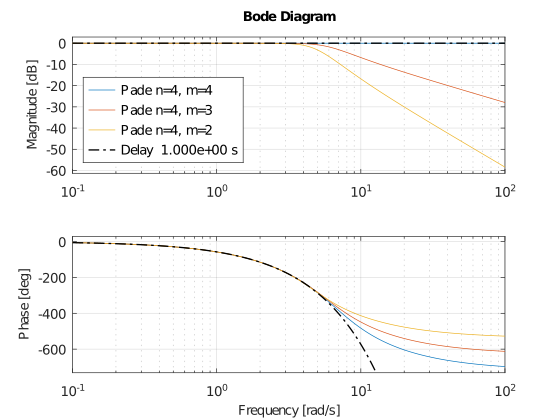
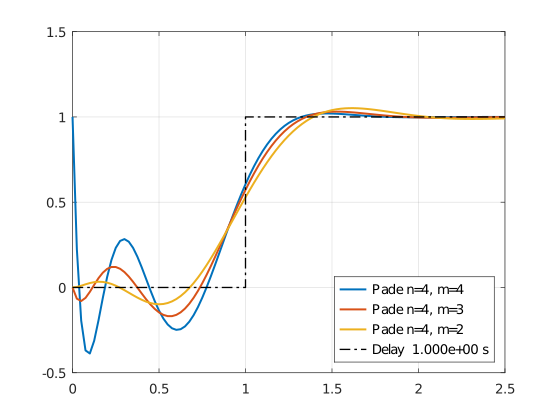
If no output argument is requested, the step response and the bode diagram of the approximatons with orders n1, m1 to nk, nk are plotted togehter with step delayed by the given dead-time T.
When using the same numbers of poles and zeros (m = n), the step response of the resulting approximation shows a step at t = 0 which is untypical for a pure time delay. However, it has a magnitude of 1 (0 dB) over all frequencies. In [1], an approximaton having less zeros than poles (m < n) is suggested as an alternative approach, resulting in a better step response but decresing magnitude for higher frequencies.
Algorithm based on:
- Vajta, M. (2000). Some remarks on Pade-approximations, pp53-58, Paper presented at 3rd TEMPUS-INTCOM Symposium on Intelligent Systems in Control and Measurements 2000, Veszprém, Hungary.
Source Code: pade
pade (1,4,4,4,3,4,2)