Categories &
Functions List
Function Reference: step
Function File: step (sys)
Function File: step (sys1, sys2, …, sysN)
Function File: step (sys1, ’style1’, …, sysN, ’styleN’)
Function File: step (sys1, …, t)
Function File: step (sys1, …, tfinal)
Function File: step (sys1, …, tfinal, dt)
Function File: [y, t, x] = step (sys)
Function File: [y, t, x] = step (sys, t)
Function File: [y, t, x] = step (sys, tfinal)
Function File: [y, t, x] = step (sys, tfinal, dt)
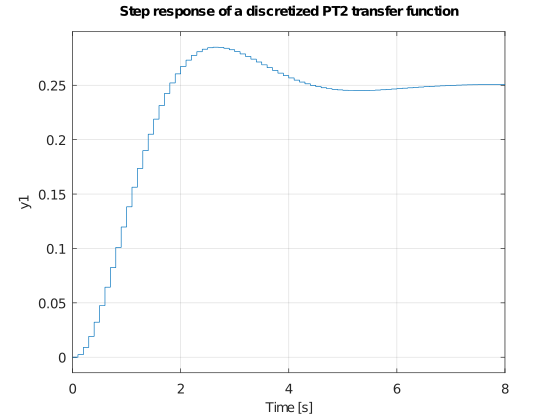
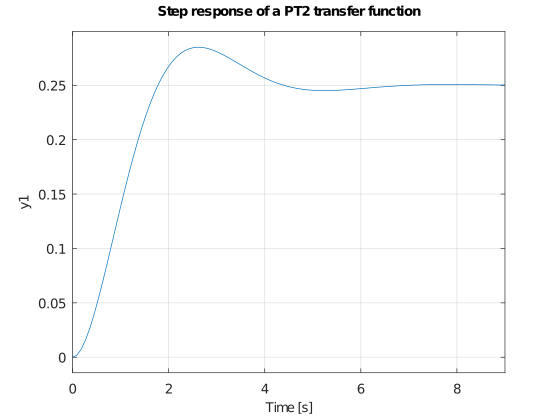
Step response of LTI system. If no output arguments are given, the response is printed on the screen.
Inputs
- sys
- LTI model.
- t
- Time vector. Should be evenly spaced. If not specified, it is calculated by the poles of the system to reflect adequately the response transients.
- tfinal
- Optional simulation horizon. If not specified, it is calculated by the poles of the system to reflect adequately the response transients.
- dt
- Optional sampling time. Be sure to choose it small enough to capture transient phenomena. If not specified, it is calculated by the poles of the system.
- ’style’
- Line style and color, e.g. ’r’ for a solid red line or ’-.k’ for a dash-dotted
black line. See
help plotfor details.
Outputs
- y
- Output response array. Has as many rows as time samples (length of t) and as many columns as outputs.
- t
- Time row vector.
- x
- State trajectories array. Has
length (t)rows and as many columns as states.
See also: stepinfo, impulse, initial, lsim
Source Code: step
 clf;
 subplot (2,1,1)
 s = tf('s');
 G1 = (1 - 1.25*s)/(1 + 1.25*s);
 G2 = (1 - .5*s + 0.1*s^2)/(1 + .5*s + 0.1*s^2);
 step(G1,G2,8);
 title ("Step response all-passes of 1st and 2nd order");
 subplot (2,1,2)
 G = 1/(0.3*s^2 + 0.3*s + 1);
 Gd = c2d(G,0.6667);
 step(G,Gd,8);
 title ("Step response PT_2 with zoh-discretization");
 clf;
 warning ("off", "Control:convert-to-state-space");
 G1 = tf({[1],[1 0]},{[1 1],[1 1 1]});
 G2 = tf  ({[1 0],[0.25];[-2 1],[1]},{[1 1 0.25],[1 1];[1.4 1],[1 1 1]});
 step (G1,G2,1.5*G2);
 warning ("on", "Control:convert-to-state-space");