Categories &
Functions List
- BetaDistribution
- BinomialDistribution
- BirnbaumSaundersDistribution
- BurrDistribution
- ExponentialDistribution
- ExtremeValueDistribution
- GammaDistribution
- GeneralizedExtremeValueDistribution
- GeneralizedParetoDistribution
- HalfNormalDistribution
- InverseGaussianDistribution
- LogisticDistribution
- LoglogisticDistribution
- LognormalDistribution
- LoguniformDistribution
- MultinomialDistribution
- NakagamiDistribution
- NegativeBinomialDistribution
- NormalDistribution
- PiecewiseLinearDistribution
- PoissonDistribution
- RayleighDistribution
- RicianDistribution
- tLocationScaleDistribution
- TriangularDistribution
- UniformDistribution
- WeibullDistribution
- betafit
- betalike
- binofit
- binolike
- bisafit
- bisalike
- burrfit
- burrlike
- evfit
- evlike
- expfit
- explike
- gamfit
- gamlike
- geofit
- gevfit_lmom
- gevfit
- gevlike
- gpfit
- gplike
- gumbelfit
- gumbellike
- hnfit
- hnlike
- invgfit
- invglike
- logifit
- logilike
- loglfit
- logllike
- lognfit
- lognlike
- nakafit
- nakalike
- nbinfit
- nbinlike
- normfit
- normlike
- poissfit
- poisslike
- raylfit
- rayllike
- ricefit
- ricelike
- tlsfit
- tlslike
- unidfit
- unifit
- wblfit
- wbllike
- betacdf
- betainv
- betapdf
- betarnd
- binocdf
- binoinv
- binopdf
- binornd
- bisacdf
- bisainv
- bisapdf
- bisarnd
- burrcdf
- burrinv
- burrpdf
- burrrnd
- bvncdf
- bvtcdf
- cauchycdf
- cauchyinv
- cauchypdf
- cauchyrnd
- chi2cdf
- chi2inv
- chi2pdf
- chi2rnd
- copulacdf
- copulapdf
- copularnd
- evcdf
- evinv
- evpdf
- evrnd
- expcdf
- expinv
- exppdf
- exprnd
- fcdf
- finv
- fpdf
- frnd
- gamcdf
- gaminv
- gampdf
- gamrnd
- geocdf
- geoinv
- geopdf
- geornd
- gevcdf
- gevinv
- gevpdf
- gevrnd
- gpcdf
- gpinv
- gppdf
- gprnd
- gumbelcdf
- gumbelinv
- gumbelpdf
- gumbelrnd
- hncdf
- hninv
- hnpdf
- hnrnd
- hygecdf
- hygeinv
- hygepdf
- hygernd
- invgcdf
- invginv
- invgpdf
- invgrnd
- iwishpdf
- iwishrnd
- jsucdf
- jsupdf
- laplacecdf
- laplaceinv
- laplacepdf
- laplacernd
- logicdf
- logiinv
- logipdf
- logirnd
- loglcdf
- loglinv
- loglpdf
- loglrnd
- logncdf
- logninv
- lognpdf
- lognrnd
- mnpdf
- mnrnd
- mvncdf
- mvnpdf
- mvnrnd
- mvtcdf
- mvtpdf
- mvtrnd
- mvtcdfqmc
- nakacdf
- nakainv
- nakapdf
- nakarnd
- nbincdf
- nbininv
- nbinpdf
- nbinrnd
- ncfcdf
- ncfinv
- ncfpdf
- ncfrnd
- nctcdf
- nctinv
- nctpdf
- nctrnd
- ncx2cdf
- ncx2inv
- ncx2pdf
- ncx2rnd
- normcdf
- norminv
- normpdf
- normrnd
- plcdf
- plinv
- plpdf
- plrnd
- poisscdf
- poissinv
- poisspdf
- poissrnd
- raylcdf
- raylinv
- raylpdf
- raylrnd
- ricecdf
- riceinv
- ricepdf
- ricernd
- tcdf
- tinv
- tpdf
- trnd
- tlscdf
- tlsinv
- tlspdf
- tlsrnd
- tricdf
- triinv
- tripdf
- trirnd
- unidcdf
- unidinv
- unidpdf
- unidrnd
- unifcdf
- unifinv
- unifpdf
- unifrnd
- vmcdf
- vminv
- vmpdf
- vmrnd
- wblcdf
- wblinv
- wblpdf
- wblrnd
- wienrnd
- wishpdf
- wishrnd
- adtest
- anova
- anova1
- anova2
- anovan
- bartlett_test
- barttest
- binotest
- chi2gof
- chi2test
- correlation_test
- fishertest
- friedman
- hotelling_t2test
- hotelling_t2test2
- kruskalwallis
- kstest
- kstest2
- levene_test
- manova1
- mcnemar_test
- multcompare
- ranksum
- regression_ftest
- regression_ttest
- runstest
- sampsizepwr
- signrank
- signtest
- tiedrank
- ttest
- ttest2
- vartest
- vartest2
- vartestn
- ztest
- ztest2
Class Definition: ExponentialDistribution
statistics: ExponentialDistribution
Exponential probability distribution object.
A ExponentialDistribution object consists of parameters, a model
description, and sample data for a exponential probability distribution.
The exponential distribution is a continuous probability distribution with mean parameter mu that models the time between events in a Poisson process.
There are several ways to create a ExponentialDistribution object.
- Fit a distribution to data using the
fitdistfunction. - Create a distribution with fixed parameter values using the
makedistfunction. - Use the constructor
ExponentialDistribution (mu)to create a exponential distribution with fixed parameter value mu. - Use the static method
ExponentialDistribution.fit (x,
 alpha, censor, freq, options)
to fit a distribution to the data in x using the same input arguments as theexpfitfunction.
It is highly recommended to use fitdist and makedist
functions to create probability distribution objects, instead of the class
constructor or the aforementioned static method.
Further information about the exponential distribution can be found at https://en.wikipedia.org/wiki/Exponential_distribution
See also: fitdist, makedist, expcdf, expinv, exppdf, exprnd, expfit, explike, expstat
Source Code: ExponentialDistribution
The ExponentialDistribution class contains the following properties:
A positive scalar value characterizing the mean of the
exponential distribution. You can access the mu
property using dot name assignment.
Example: 1
Create an Exponential distribution with default parameter
pd = makedist ("Exponential")
pd =
  ExponentialDistribution

  exponential distribution
       mu = 1
Query parameter 'mu' (mean parameter)
pd.mu
ans = 1
Set parameter 'mu'
pd.mu = 2
pd =
  ExponentialDistribution

  exponential distribution
       mu = 2
Use this to initialize or modify the mean parameter of an Exponential distribution. The mean parameter must be a positive real scalar.
Example: 2
Create an Exponential distribution object by calling its constructor
pd = ExponentialDistribution (1.5)
pd =
  ExponentialDistribution

  exponential distribution
       mu = 1.5
Query parameter 'mu'
pd.mu
ans = 1.5000
This demonstrates direct construction with a specific mean parameter, useful for modeling waiting times with a known average.
A character vector specifying the name of the probability distribution object. This property is read-only.
A scalar integer value specifying the number of parameters characterizing the probability distribution. This property is read-only.
A cell array of character vectors with each element containing the name of a distribution parameter. This property is read-only.
A cell array of character vectors with each element containing a short description of a distribution parameter. This property is read-only.
A numeric vector containing the value of the distribution
parameter. This property is read-only. You can change the distribution
parameter by assigning a new value to the mu
property.
A scalar numeric value containing the variance-covariance of the parameter estimate. The covariance matrix is only meaningful when the distribution was fitted to data. If the distribution object was created with fixed parameters, or a parameter of a fitted distribution is modified, then the variance-covariance is zero. This property is read-only.
A logical vector specifying whether the parameter is fixed or
estimated. true value corresponds to fixed parameter,
false value corresponds to parameter estimate. This property is
read-only.
A numeric vector specifying the truncation interval for the
probability distribution. First element contains the lower boundary,
second element contains the upper boundary. This property is read-only.
You can only truncate a probability distribution with the
truncate method.
A logical scalar value specifying whether a probability distribution is truncated or not. This property is read-only.
A scalar structure containing the following fields:
-
data: a numeric vector containing the data used for distribution fitting. -
cens: a numeric vector of logical values indicating censoring information corresponding to the elements of the data used for distribution fitting. If no censoring vector was used for distribution fitting, then this field defaults to an empty array. -
freq: a numeric vector of non-negative integer values containing the frequency information corresponding to the elements of the data used for distribution fitting. If no frequency vector was used for distribution fitting, then this field defaults to an empty array.
The ExponentialDistribution class offers the following public methods:
ExponentialDistribution: p = cdf (pd, x)
ExponentialDistribution: p = cdf (pd, x,
'upper')
p = cdf (pd, x) computes the CDF of the
probability distribution object, pd, evaluated at the values in
x.
p = cdf (…, returns the complement of
the CDF of the probability distribution object, pd, evaluated at
the values in x.
'upper')
Example: 1
Plot various CDFs from the Exponential distribution
 x = 0:0.01:10;
 pd1 = makedist ("Exponential", "mu", 1);
 pd2 = makedist ("Exponential", "mu", 2);
 pd3 = makedist ("Exponential", "mu", 3);
 p1 = cdf (pd1, x);
 p2 = cdf (pd2, x);
 p3 = cdf (pd3, x);
 plot (x, p1, "-b", x, p2, "-g", x, p3, "-r")
 grid on
 legend ({"mu = 1", "mu = 2", "mu = 3"}, "location", "southeast")
 title ("Exponential CDF")
 xlabel ("values in x")
 ylabel ("Cumulative probability")
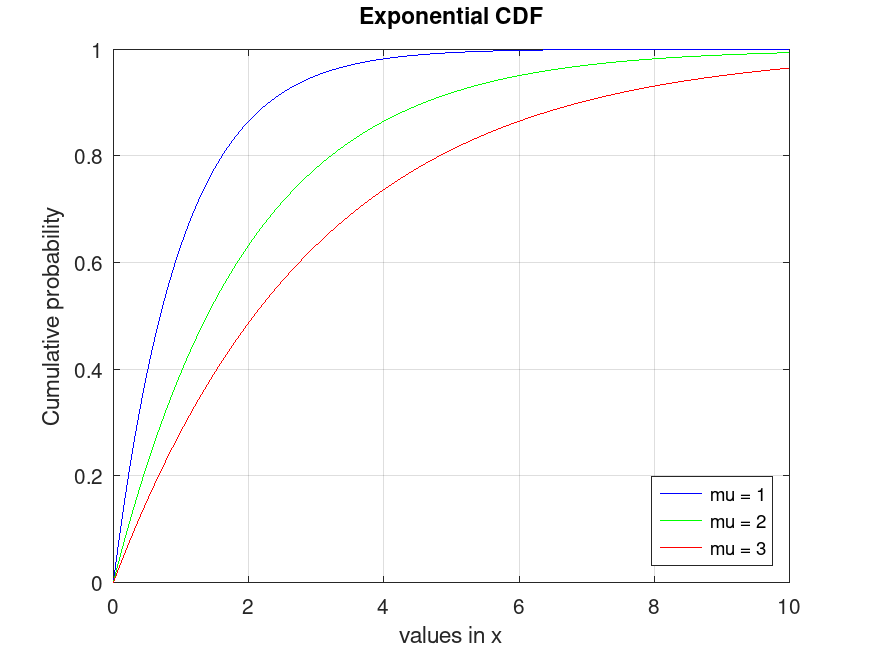
Use this to compute and visualize the cumulative distribution function for different Exponential distributions, showing how probability accumulates over values.
ExponentialDistribution: x = icdf (pd, p)
x = icdf (pd, p) computes the quantile (the
inverse of the CDF) of the probability distribution object, pd,
evaluated at the values in p.
Example: 1
Plot various iCDFs from the Exponential distribution
 p = 0.001:0.001:0.999;
 pd1 = makedist ("Exponential", "mu", 1);
 pd2 = makedist ("Exponential", "mu", 2);
 pd3 = makedist ("Exponential", "mu", 3);
 x1 = icdf (pd1, p);
 x2 = icdf (pd2, p);
 x3 = icdf (pd3, p);
 plot (p, x1, "-b", p, x2, "-g", p, x3, "-r")
 grid on
 legend ({"mu = 1", "mu = 2", "mu = 3"}, "location", "northwest")
 title ("Exponential iCDF")
 xlabel ("Probability")
 ylabel ("values in x")
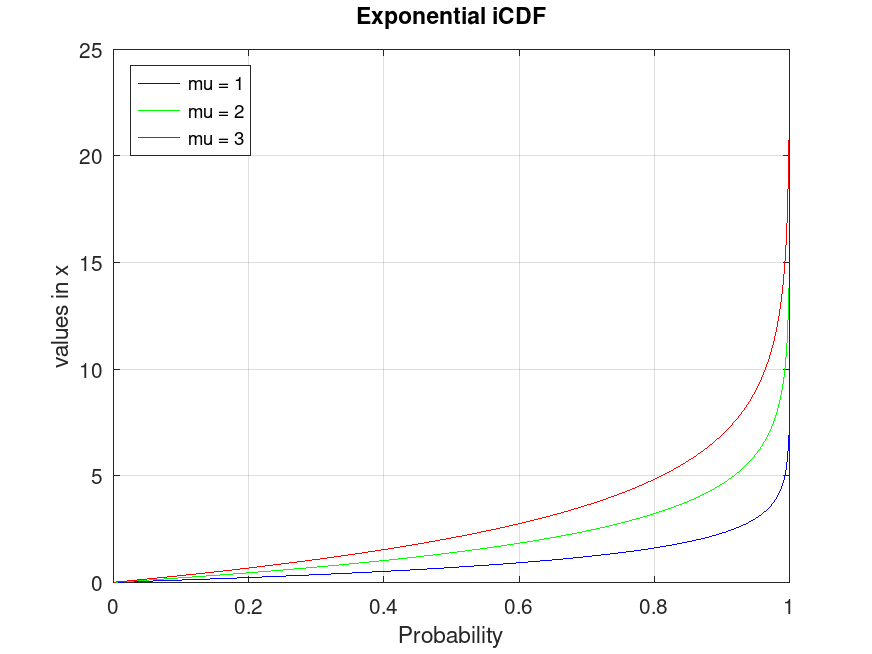
This demonstrates the inverse CDF (quantiles) for Exponential distributions, useful for finding values corresponding to given probabilities.
ExponentialDistribution: r = iqr (pd)
r = iqr (pd) computes the interquartile range of the
probability distribution object, pd.
Example: 1
Compute the interquartile range for an Exponential distribution
pd = makedist ("Exponential", "mu", 2)
pd =
  ExponentialDistribution

  exponential distribution
       mu = 2
iqr_value = iqr (pd)
iqr_value = 2.1972
Use this to calculate the interquartile range, which measures the spread of the middle 50% of the distribution, useful for understanding variability in waiting times.
ExponentialDistribution: m = mean (pd)
m = mean (pd) computes the mean of the probability
distribution object, pd.
Example: 1
Compute the mean for different Exponential distributions
 pd1 = makedist ("Exponential", "mu", 1);
 pd2 = makedist ("Exponential", "mu", 2);
 mean1 = mean (pd1)
mean1 = 1
mean2 = mean (pd2)
mean2 = 2
This shows how to compute the expected value for Exponential distributions with different mean parameters.
ExponentialDistribution: m = median (pd)
m = median (pd) computes the median of the probability
distribution object, pd.
Example: 1
Compute the median for different Exponential distributions
 pd1 = makedist ("Exponential", "mu", 1);
 pd2 = makedist ("Exponential", "mu", 2);
 median1 = median (pd1)
median1 = 0.6931
median2 = median (pd2)
median2 = 1.3863
Use this to find the median value, which splits the distribution into two equal probability halves.
ExponentialDistribution: nlogL = negloglik (pd)
nlogL = negloglik (pd) computes the negative
loglikelihood of the probability distribution object, pd.
Example: 1
Compute the negative loglikelihood for a fitted Exponential distribution
pd = makedist ("Exponential", "mu", 2)
pd =
  ExponentialDistribution

  exponential distribution
       mu = 2
 rand ("seed", 5);
 data = random (pd, 100, 1);
 pd_fitted = fitdist (data, "Exponential")
pd_fitted =
  ExponentialDistribution

  exponential distribution
       mu = 2.22357   [1.84484, 2.73286]
nlogL = negloglik (pd_fitted)
nlogL = -179.91
This is useful for assessing the fit of an Exponential distribution to data, lower values indicate a better fit.
ExponentialDistribution: ci = paramci (pd)
ExponentialDistribution: ci = paramci (pd, Name, Value)
ci = paramci (pd) computes the lower and upper
boundaries of the 95% confidence interval for each parameter of the
probability distribution object, pd.
ci = paramci (pd, Name, Value) computes
the
confidence intervals with additional options specified by
Name-Value pair arguments listed below.
| Name | Value | |
|---|---|---|
'Alpha' | A scalar value in the range specifying the significance level for the confidence interval. The default value 0.05 corresponds to a 95% confidence interval. | |
'Parameter' | A character vector or a cell array of
character vectors specifying the parameter names for which to compute
confidence intervals. By default, paramci computes confidence
intervals for all distribution parameters. |
paramci is meaningful only when pd is fitted to data,
otherwise an empty array, [], is returned.
Example: 1
Compute confidence intervals for parameters of a fitted Exponential distribution
pd = makedist ("Exponential", "mu", 2)
pd =
  ExponentialDistribution

  exponential distribution
       mu = 2
 rand ("seed", 5);
 data = random (pd, 1000, 1);
 pd_fitted = fitdist (data, "Exponential")
pd_fitted =
  ExponentialDistribution

  exponential distribution
       mu = 1.96471   [1.8484, 2.0924]
ci = paramci (pd_fitted, "Alpha", 0.05)
ci =

   1.8484
   2.0924
Use this to obtain confidence intervals for the estimated parameter (mu), providing a range of plausible values given the data.
ExponentialDistribution: y = pdf (pd, x)
y = pdf (pd, x) computes the PDF of the
probability distribution object, pd, evaluated at the values in
x.
Example: 1
Plot various PDFs from the Exponential distribution
 x = 0:0.01:10;
 pd1 = makedist ("Exponential", "mu", 1);
 pd2 = makedist ("Exponential", "mu", 2);
 pd3 = makedist ("Exponential", "mu", 3);
 y1 = pdf (pd1, x);
 y2 = pdf (pd2, x);
 y3 = pdf (pd3, x);
 plot (x, y1, "-b", x, y2, "-g", x, y3, "-r")
 grid on
 legend ({"mu = 1", "mu = 2", "mu = 3"}, "location", "northeast")
 title ("Exponential PDF")
 xlabel ("values in x")
 ylabel ("Probability density")
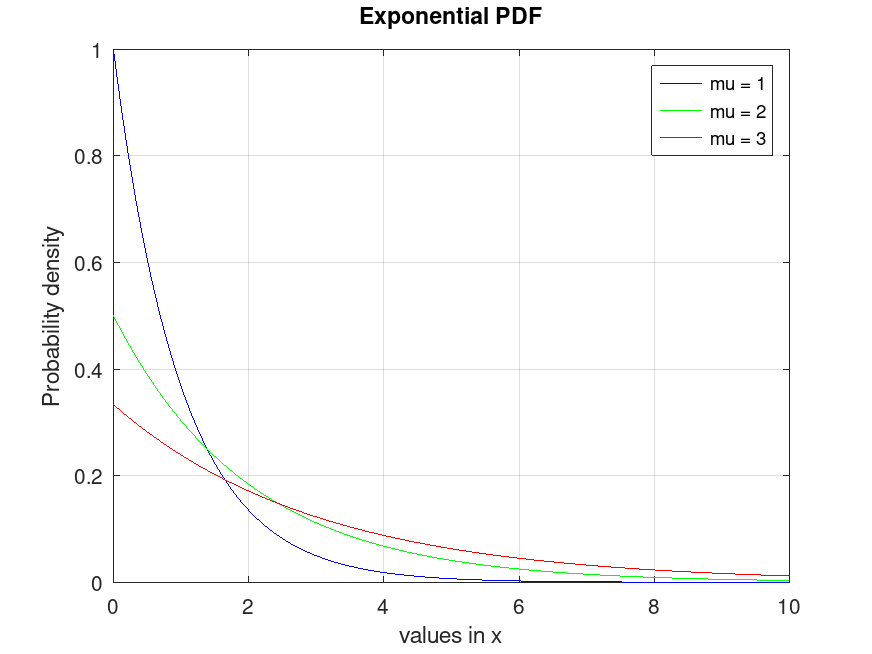
This visualizes the probability density function for Exponential distributions, showing the likelihood of different values.
ExponentialDistribution: plot (pd)
ExponentialDistribution: plot (pd, Name, Value)
ExponentialDistribution: h = plot (…)
plot (pd) plots a probability density function (PDF) of the
probability distribution object pd. If pd contains data,
which have been fitted by fitdist, the PDF is superimposed over a
histogram of the data.
plot (pd, Name, Value) specifies additional
options with the Name-Value pair arguments listed below.
| Name | Value | |
|---|---|---|
'PlotType' | A character vector specifying the plot
type. 'pdf' plots the probability density function (PDF). When
pd is fit to data, the PDF is superimposed on a histogram of the
data. 'cdf' plots the cumulative density function (CDF). When
pd is fit to data, the CDF is superimposed over an empirical CDF.
'probability' plots a probability plot using a CDF of the data
and a CDF of the fitted probability distribution. This option is
available only when pd is fitted to data. | |
'Discrete' | A logical scalar to specify whether to
plot the PDF or CDF of a discrete distribution object as a line plot or a
stem plot, by specifying false or true, respectively. By
default, it is true for discrete distributions and false
for continuous distributions. When pd is a continuous distribution
object, option is ignored. | |
'Parent' | An axes graphics object for plot. If
not specified, the plot function plots into the current axes or
creates a new axes object if one does not exist. |
h = plot (…) returns a graphics handle to the plotted
objects.
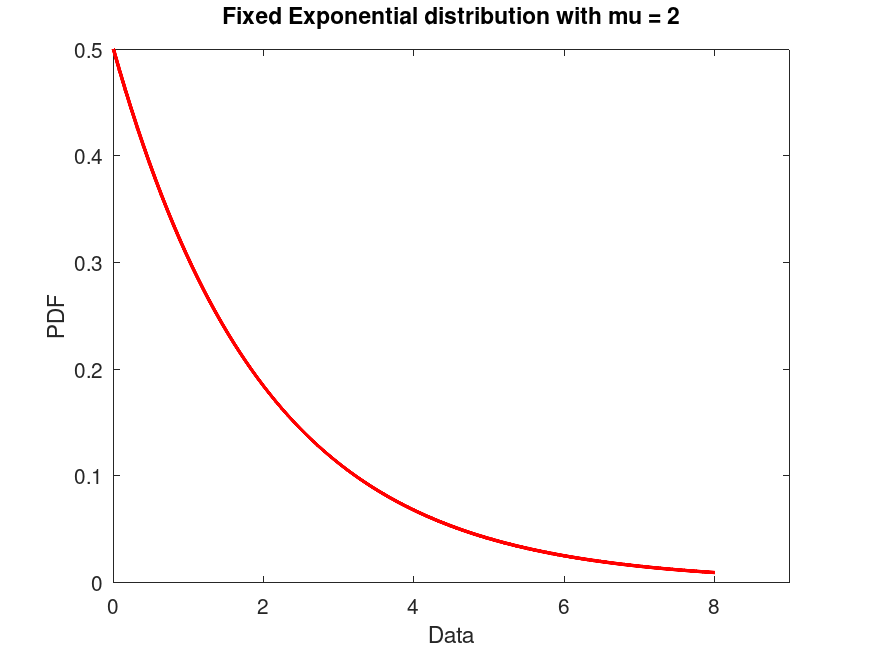
Example: 1
Create an Exponential distribution with fixed parameter mu = 2 and plot its PDF.
pd = makedist ("Exponential", "mu", 2)
pd =
  ExponentialDistribution

  exponential distribution
       mu = 2
 plot (pd)
 title ("Fixed Exponential distribution with mu = 2")
Example: 2
Generate a data set of 100 random samples from an Exponential distribution with parameter mu = 2. Fit an Exponential distribution to this data and plot its CDF superimposed over an empirical CDF.
pd_fixed = makedist ("Exponential", "mu", 2)
pd_fixed =
  ExponentialDistribution

  exponential distribution
       mu = 2
 rand ("seed", 5);
 data = random (pd_fixed, 100, 1);
 pd_fitted = fitdist (data, "Exponential")
pd_fitted =
  ExponentialDistribution

  exponential distribution
       mu = 2.19518   [1.82129, 2.69797]
 plot (pd_fitted, "PlotType", "cdf")
 txt = "Fitted Exponential distribution with mu = %0.2f";
 title (sprintf (txt, pd_fitted.mu))
 legend ({"empirical CDF", "fitted CDF"}, "location", "southeast")
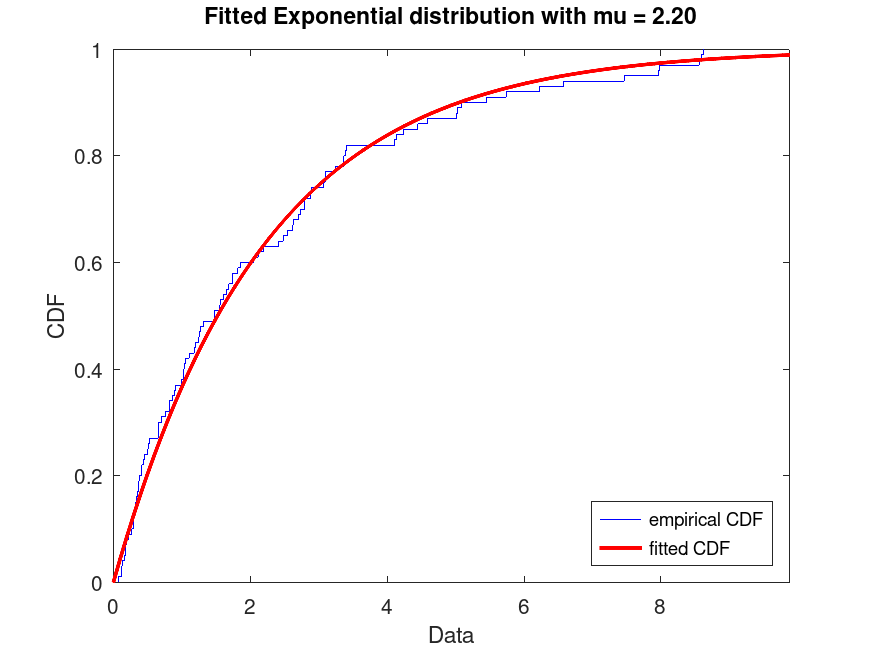
Use this to visualize the fitted CDF compared to the empirical CDF of the data, useful for assessing model fit.
Example: 3
Generate a data set of 200 random samples from an Exponential distribution with parameter mu = 2. Display a probability plot for the Exponential distribution fit to the data.
pd_fixed = makedist ("Exponential", "mu", 2)
pd_fixed =
  ExponentialDistribution

  exponential distribution
       mu = 2
 rand ("seed", 5);
 data = random (pd_fixed, 200, 1);
 pd_fitted = fitdist (data, "Exponential")
pd_fitted =
  ExponentialDistribution

  exponential distribution
       mu = 1.92184   [1.68101, 2.21869]
 plot (pd_fitted, "PlotType", "probability")
 txt = strcat ("Probability plot of fitted Exponential", ...
               " distribution with mu = %0.2f");
 title (sprintf (txt, pd_fitted.mu))
 legend ({"empirical CDF", "fitted CDF"}, "location", "southeast")
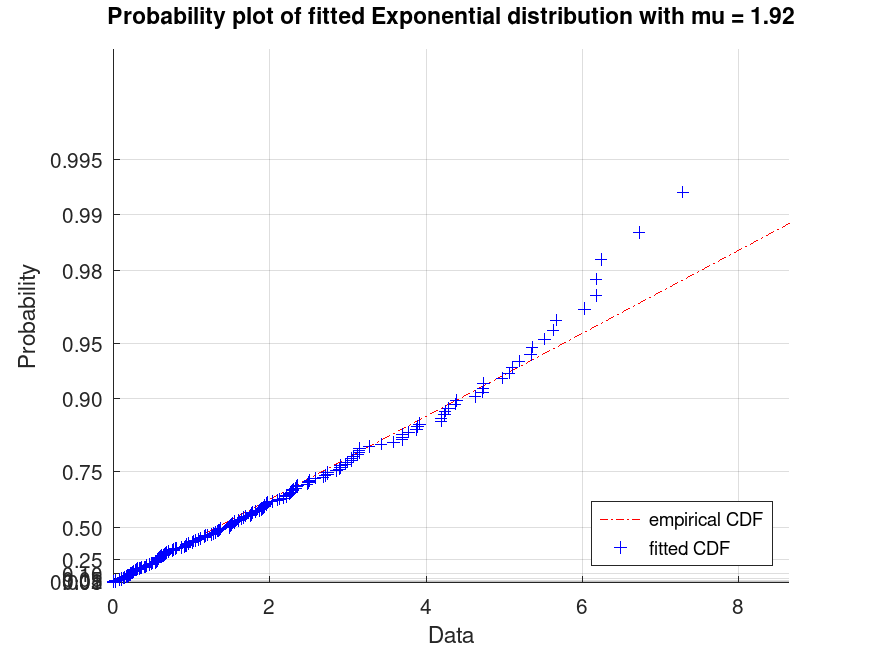
This creates a probability plot to compare the fitted distribution to the data, useful for checking if the Exponential model is appropriate.
ExponentialDistribution: [nlogL, param] = proflik (pd, pnum)
ExponentialDistribution: [nlogL, param] = proflik (pd, pnum,
'Display', display)ExponentialDistribution: [nlogL, param] = proflik (pd, pnum, setparam)
ExponentialDistribution: [nlogL, param] = proflik (pd, pnum, setparam,
'Display', display)
[nlogL, param] = proflik (pd, pnum)
returns a vector nlogL of negative loglikelihood values and a
vector param of corresponding parameter values for the parameter in
the position indicated by pnum. By default, proflik uses
the lower and upper bounds of the 95% confidence interval and computes
100 equispaced values for the selected parameter. pd must be
fitted to data.
[nlogL, param] = proflik (pd, pnum,
also plots the profile likelihood
against the default range of the selected parameter.
'Display', 'on')
[nlogL, param] = proflik (pd, pnum,
 setparam)
defines a user-defined range of the selected parameter.
[nlogL, param] = proflik (pd, pnum,
setparam, also plots the profile
likelihood against the user-defined range of the selected parameter.
'Display', 'on')
For the exponential distribution, pnum = 1 selects the
parameter mu.
When opted to display the profile likelihood plot, proflik also
plots the baseline loglikelihood computed at the lower bound of the 95%
confidence interval and estimated maximum likelihood. The latter might
not be observable if it is outside of the used-defined range of parameter
values.
Example: 1
Compute and plot the profile likelihood for the mean parameter of a fitted Exponential distribution
pd = makedist ("Exponential", "mu", 2)
pd =
  ExponentialDistribution

  exponential distribution
       mu = 2
 rand ("seed", 5);
 data = random (pd, 1000, 1);
 pd_fitted = fitdist (data, "Exponential")
pd_fitted =
  ExponentialDistribution

  exponential distribution
       mu = 1.97974   [1.86255, 2.10841]
[nlogL, param] = proflik (pd_fitted, 1, "Display", "on");
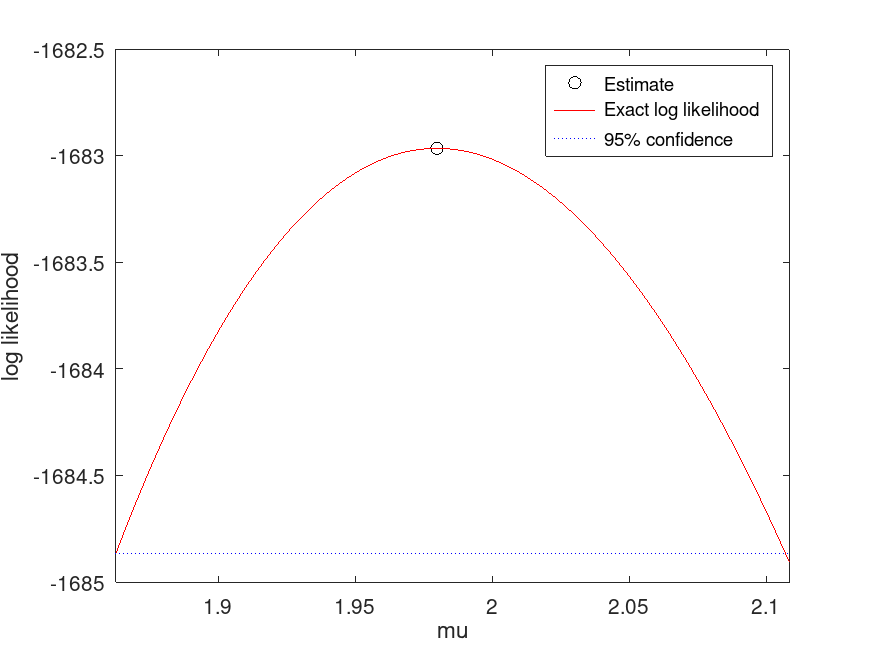
Use this to analyze the profile likelihood of the mean parameter (mu), helping to understand the uncertainty in parameter estimates given the data.
ExponentialDistribution: r = random (pd)
ExponentialDistribution: r = random (pd, rows)
ExponentialDistribution: r = random (pd, rows, cols, …)
ExponentialDistribution: r = random (pd, [sz])
r = random (pd) returns a random number from the
distribution object pd.
When called with a single size argument, betarnd returns a square
matrix with the dimension specified. When called with more than one
scalar argument, the first two arguments are taken as the number of rows
and columns and any further arguments specify additional matrix
dimensions. The size may also be specified with a row vector of
dimensions, sz.
Example: 1
Generate random samples from an Exponential distribution
pd = makedist ("Exponential", "mu", 2)
pd =
  ExponentialDistribution

  exponential distribution
       mu = 2
 rand ("seed", 5);
 samples = random (pd, 500, 1);
 hist (samples, 50)
 title ("Histogram of 500 random samples from Exponential(mu=2)")
 xlabel ("values in x")
 ylabel ("Frequency")
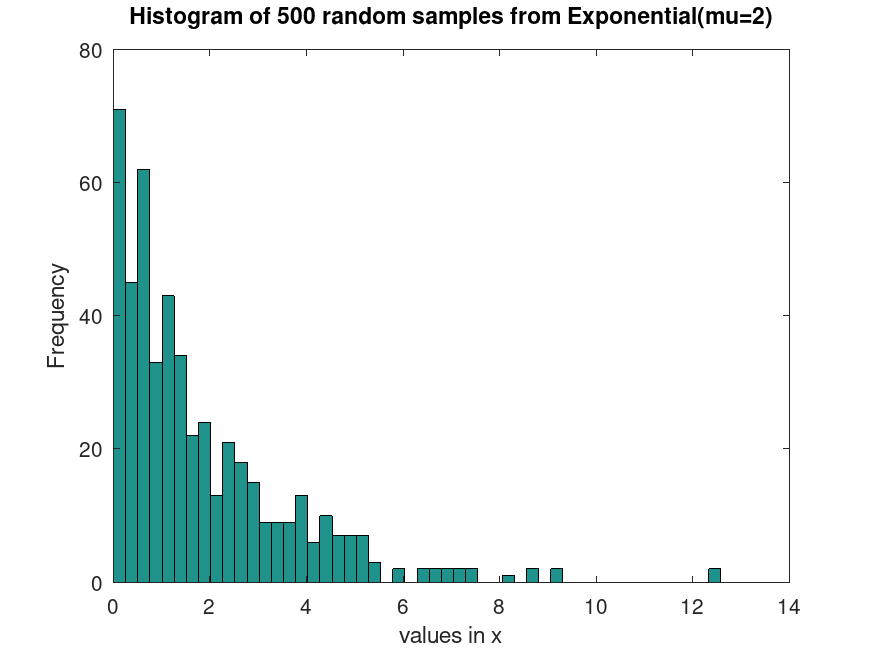
This generates random samples from an Exponential distribution, useful for simulating waiting times or inter-arrival times.
ExponentialDistribution: s = std (pd)
s = std (pd) computes the standard deviation of the
probability distribution object, pd.
Example: 1
Compute the standard deviation for an Exponential distribution
pd = makedist ("Exponential", "mu", 2)
pd =
  ExponentialDistribution

  exponential distribution
       mu = 2
std_value = std (pd)
std_value = 2
Use this to calculate the standard deviation, which measures the variability in the distribution.
ExponentialDistribution: t = truncate (pd, lower, upper)
t = truncate (pd, lower, upper) returns a
probability distribution t, which is the probability distribution
pd truncated to the specified interval with lower limit,
lower,
and upper limit, upper. If pd is fitted to data with
fitdist, the returned probability distribution t is not
fitted, does not contain any data or estimated values, and it is as it
has been created with the makedist function, but it includes the
truncation interval.
Example: 1
Plot the PDF of an Exponential distribution, with parameter mu = 2, truncated at [1, 5] intervals. Generate 10000 random samples from this truncated distribution and superimpose a histogram scaled accordingly
pd = makedist ("Exponential", "mu", 2)
pd =
  ExponentialDistribution

  exponential distribution
       mu = 2
t = truncate (pd, 1, 3)
t =
  ExponentialDistribution

  exponential distribution
       mu = 2
  Truncated to the interval [1, 3]
 rand ("seed", 5);
 data = random (t, 10000, 1);
Plot histogram and fitted PDF
 plot (t)
 hold on
 hist (data, 100, 50)
 hold off
 title ("Exponential distribution (mu = 2) truncated at [1, 5]")
 legend ("Truncated PDF", "Histogram")
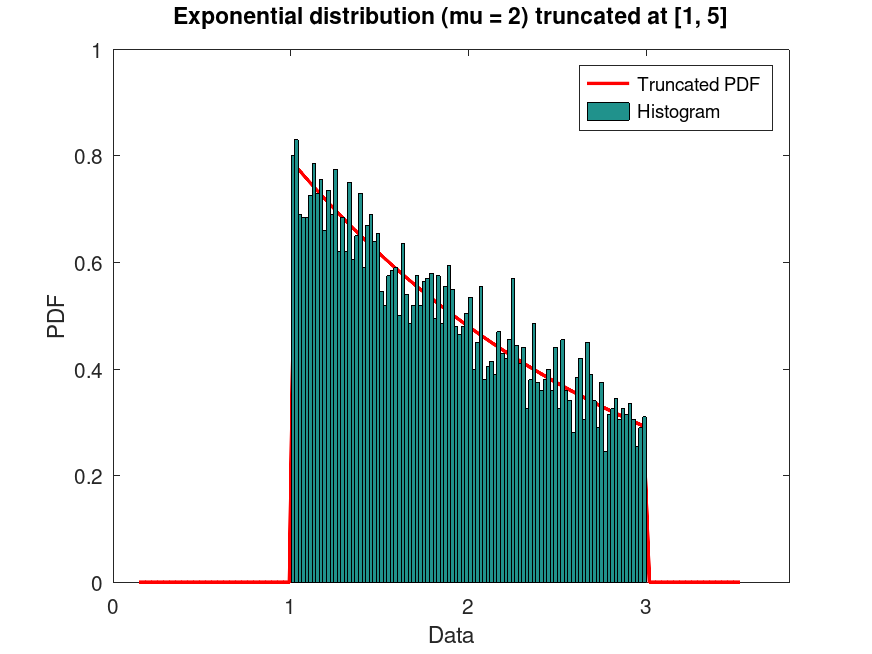
This demonstrates truncating an Exponential distribution to a specific range and visualizing the resulting distribution with random samples.
ExponentialDistribution: v = var (pd)
v = var (pd) computes the variance of the
probability distribution object, pd.
Example: 1
Compute the variance for an Exponential distribution
pd = makedist ("Exponential", "mu", 2)
pd =
  ExponentialDistribution

  exponential distribution
       mu = 2
var_value = var (pd)
var_value = 4
Use this to calculate the variance, which quantifies the spread of the distribution.