Categories &
Functions List
- adtest
- anova
- anova1
- anova2
- anovan
- ansaribradley
- barttest
- binotest
- chi2gof
- chi2test
- correlation_test
- detectdrift
- dwtest
- fishertest
- friedman
- hotelling_t2test
- hotelling_t2test2
- jbtest
- knntest
- kruskalwallis
- kstest
- kstest2
- lillietest
- manova1
- mcnemar_test
- meanEffectSize
- mmdtest
- multcompare
- ranksum
- regression_ftest
- regression_ttest
- runstest
- signrank
- signtest
- stats.drift.DriftDiagnostics
- swtest
- ttest
- ttest2
- vartest
- vartest2
- vartestn
- ztest
- ztest2
- CompactLinearModel
- CoxModel
- coxphfit
- fitcox
- fitglm
- fitglme
- fitlm
- fitlme
- fitlmematrix
- fitnlm
- fitrm
- GeneralizedLinearMixedModel
- GeneralizedLinearModel
- glmfit
- glmval
- invpred
- lasso
- lassoglm
- LinearFormula
- LinearMixedModel
- LinearModel
- logistic_regression
- mnrfit
- mnrval
- monotone_smooth
- mvregress
- mvregresslike
- nlinfit
- nlparci
- nlpredci
- NonLinearModel
- plsregress
- regress
- regress_gp
- RepeatedMeasuresModel
- ridge
- robustfit
- stepwisefit
- stepwiseglm
- stepwiselm
- ClassificationBaggedEnsemble
- ClassificationDiscriminant
- ClassificationECOC
- ClassificationEnsemble
- ClassificationGAM
- ClassificationKernel
- ClassificationKNN
- ClassificationLinear
- ClassificationNaiveBayes
- ClassificationNeuralNetwork
- ClassificationPartitionedECOC
- ClassificationPartitionedEnsemble
- ClassificationPartitionedKernel
- ClassificationPartitionedLinear
- ClassificationPartitionedModel
- ClassificationSVM
- ClassificationTree
- CompactClassificationDiscriminant
- CompactClassificationECOC
- CompactClassificationEnsemble
- CompactClassificationGAM
- CompactClassificationNaiveBayes
- CompactClassificationNeuralNetwork
- CompactClassificationSVM
- CompactClassificationTree
- CompactRegressionGAM
- CompactRegressionEnsemble
- CompactRegressionGP
- CompactRegressionNeuralNetwork
- CompactRegressionSVM
- CompactRegressionTree
- CompactTreeBagger
- designecoc
- fcnnpredict
- fcnntrain
- fitcdiscr
- fitcecoc
- fitcensemble
- fitcgam
- fitckernel
- fitcknn
- fitclinear
- fitcnb
- fitcnet
- fitcsvm
- fitctree
- fitrensemble
- fitrgam
- fitrgp
- fitrkernel
- fitrlinear
- fitrnet
- fitrsvm
- fitrtree
- gamboostinter
- gamboostpairs
- gamboostpredict
- gamboosttrain
- gampredict
- gamtrain
- partialDependence
- plotPartialDependence
- PredictiveModel
- RegressionBaggedEnsemble
- RegressionEnsemble
- RegressionGAM
- RegressionGP
- RegressionKernel
- RegressionLinear
- RegressionNeuralNetwork
- RegressionPartitionedEnsemble
- RegressionPartitionedKernel
- RegressionPartitionedLinear
- RegressionPartitionedModel
- RegressionSVM
- RegressionTree
- lime
- shapley
- svmpredict
- svmtrain
- templateDiscriminant
- templateEnsemble
- templateKernel
- templateKNN
- templateLinear
- templateNaiveBayes
- templateSVM
- templateTree
- TreeBagger
- treepredict
- treetrain
- paretotails
- prob.ProbabilityDistribution
- prob.BetaDistribution
- prob.BinomialDistribution
- prob.BirnbaumSaundersDistribution
- prob.BurrDistribution
- prob.ExponentialDistribution
- prob.ExtremeValueDistribution
- prob.GammaDistribution
- prob.GeneralizedExtremeValueDistribution
- prob.GeneralizedParetoDistribution
- prob.HalfNormalDistribution
- prob.InverseGaussianDistribution
- prob.KernelDistribution
- prob.LogisticDistribution
- prob.LoglogisticDistribution
- prob.LognormalDistribution
- prob.LoguniformDistribution
- prob.MultinomialDistribution
- prob.NakagamiDistribution
- prob.NegativeBinomialDistribution
- prob.NormalDistribution
- prob.PiecewiseLinearDistribution
- prob.PoissonDistribution
- prob.RayleighDistribution
- prob.RicianDistribution
- prob.StableDistribution
- prob.tLocationScaleDistribution
- prob.TriangularDistribution
- prob.UniformDistribution
- prob.WeibullDistribution
- betafit
- betalike
- binofit
- binolike
- bisafit
- bisalike
- burrfit
- burrlike
- copulafit
- evfit
- evlike
- expfit
- explike
- gamfit
- gamlike
- geofit
- gevfit
- gevlike
- gevfit_lmom
- gpfit
- gplike
- gumbelfit
- gumbellike
- hnfit
- hnlike
- invgfit
- invglike
- logifit
- logilike
- loglfit
- logllike
- lognfit
- lognlike
- nakafit
- nakalike
- nbinfit
- nbinlike
- normfit
- normlike
- poissfit
- poisslike
- raylfit
- rayllike
- ricefit
- ricelike
- stblfit
- stbllike
- tlsfit
- tlslike
- unidfit
- unifit
- wblfit
- wbllike
- betacdf
- betainv
- betapdf
- betarnd
- binocdf
- binoinv
- binopdf
- binornd
- bisacdf
- bisainv
- bisapdf
- bisarnd
- burrcdf
- burrinv
- burrpdf
- burrrnd
- bvncdf
- bvtcdf
- cauchycdf
- cauchyinv
- cauchypdf
- cauchyrnd
- chi2cdf
- chi2inv
- chi2pdf
- chi2rnd
- copulacdf
- copulapdf
- copularnd
- evcdf
- evinv
- evpdf
- evrnd
- expcdf
- expinv
- exppdf
- exprnd
- fcdf
- finv
- fpdf
- frnd
- gamcdf
- gaminv
- gampdf
- gamrnd
- geocdf
- geoinv
- geopdf
- geornd
- gevcdf
- gevinv
- gevpdf
- gevrnd
- gpcdf
- gpinv
- gppdf
- gprnd
- gumbelcdf
- gumbelinv
- gumbelpdf
- gumbelrnd
- hncdf
- hninv
- hnpdf
- hnrnd
- hygecdf
- hygeinv
- hygepdf
- hygernd
- invgcdf
- invginv
- invgpdf
- invgrnd
- iwishpdf
- iwishrnd
- jsucdf
- jsupdf
- laplacecdf
- laplaceinv
- laplacepdf
- laplacernd
- logicdf
- logiinv
- logipdf
- logirnd
- loglcdf
- loglinv
- loglpdf
- loglrnd
- logncdf
- logninv
- lognpdf
- lognrnd
- mnpdf
- mnrnd
- mvncdf
- mvnpdf
- mvnrnd
- mvtcdf
- mvtpdf
- mvtrnd
- nakacdf
- nakainv
- nakapdf
- nakarnd
- nbincdf
- nbininv
- nbinpdf
- nbinrnd
- ncfcdf
- ncfinv
- ncfpdf
- ncfrnd
- nctcdf
- nctinv
- nctpdf
- nctrnd
- ncx2cdf
- ncx2inv
- ncx2pdf
- ncx2rnd
- normcdf
- norminv
- normpdf
- normrnd
- plcdf
- plinv
- plpdf
- plrnd
- poisscdf
- poissinv
- poisspdf
- poissrnd
- raylcdf
- raylinv
- raylpdf
- raylrnd
- ricecdf
- riceinv
- ricepdf
- ricernd
- stblcdf
- stblinv
- stblpdf
- stblrnd
- stdrcdf
- stdrinv
- stdrpdf
- stdrrnd
- tcdf
- tinv
- tpdf
- trnd
- tlscdf
- tlsinv
- tlspdf
- tlsrnd
- tricdf
- triinv
- tripdf
- trirnd
- unidcdf
- unidinv
- unidpdf
- unidrnd
- unifcdf
- unifinv
- unifpdf
- unifrnd
- vmcdf
- vminv
- vmpdf
- vmrnd
- wblcdf
- wblinv
- wblpdf
- wblrnd
- wienrnd
- wishpdf
- wishrnd
- betastat
- binostat
- bisastat
- burrstat
- chi2stat
- copulaparam
- copulastat
- evstat
- expstat
- fstat
- gamstat
- geostat
- gevstat
- gpstat
- gumbelstat
- hnstat
- hygestat
- invgstat
- logistat
- loglstat
- lognstat
- nakastat
- nbinstat
- ncfstat
- nctstat
- ncx2stat
- normstat
- plstat
- poisstat
- raylstat
- ricestat
- stdrstat
- tlsstat
- tristat
- tstat
- unidstat
- unifstat
- wblstat
- andrewsplot
- bar3
- bar3h
- biplot
- boxchart
- boxplot
- cdfplot
- dendrogram
- ecdfhist
- einstein
- gardnerAltmanPlot
- glyphplot
- gplotmatrix
- gscatter
- heatmap
- hist3
- histfit
- manovacluster
- normplot
- parallelcoords
- parallelplot
- ppplot
- probplot
- qqplot
- scatterhist
- scatterhistogram
- silhouette
- stats.chart.BoxChart
- stats.chart.HeatmapChart
- stats.chart.ParallelCoordinatesPlot
- stats.chart.ScatterHistogramChart
- swarmchart
- violin
- wblplot
Function Reference: fitcensemble
statistics: Mdl = fitcensemble (X, Y)
statistics: Mdl = fitcensemble (Tbl, ResponseVarName)
statistics: Mdl = fitcensemble (Tbl, formula)
statistics: Mdl = fitcensemble (Tbl, Y)
statistics: Mdl = fitcensemble (…, name, value)
Fit an ensemble of decision trees for classification.
Mdl = fitcensemble (X, Y) grows 100 boosted
decision trees on the NxP predictor matrix X and the class
labels Y, LogitBoost for two classes and AdaBoostM2 for more, and
returns a ClassificationEnsemble. With 'Method' set to
'Bag', or with a boosting method that resamples, it returns a
ClassificationBaggedEnsemble.
Y holds a class label per row of X, as a numeric or logical vector, a categorical, string or character array, or a cell array of character vectors. A row missing a predictor or a class is left out.
The boosting methods, y being +1 for the first class and -1 for the
second, d the observation weights, which start at W times the
total cost of misclassifying each observation’s class, and eta the
learning rate:
-
'AdaBoostM1' - Two classes. Each tree is grown with the weights d; h is +1
where it predicts the first class and -1 elsewhere, e its weighted
error, and its weight
eta * log ((1 - e) / e) / 2. The weights are then multiplied byexp (-weight * y .* h). -
'AdaBoostM2' - More than two classes. A weight is kept for each observation and each class other than its own, and each tree is grown with their sums; its pseudo-loss e over its class probabilities gives its weight as for AdaBoostM1, and the scores are the weighted sums of the class probabilities.
-
'RUSBoost' - Two or more classes, for classes of unequal size. Each tree is grown
without weights on a sample of every class,
round (r * m)rows, m being the size of the smallest class and r the class’s element of'RatioToSmallest', drawn in proportion to d and with replacement only when the class holds fewer rows. Its pseudo-loss e over all the observations, the weight of each spread evenly over the classes other than its own, gives its weight as for AdaBoostM1, the weights are then multiplied by the mean over those classes ofexp (-weight * (1 + h_true - h_k)), and the scores are as for AdaBoostM2. A perfect tree is kept as for AdaBoostM2. -
'LPBoost' - Two or more classes. Each tree is grown with the weights d, and its
margins and edge are as for TotalBoost. A linear program over the trees
with the new one, solved by GLPK, gives the least over distributions of
their largest edge; when the smallest edge is no more than
'MarginPrecision'above it, the new tree is not kept and the fit stops. Otherwise the program gives the learner weights that maximise the smallest margin, and as its dual the next weights d. The scores are as for TotalBoost. Where the program has several solutions, MATLAB and this package may choose different ones: the learner weights, and the weights d with the trees grown on them, then differ, and so may the number of trees kept. MATLAB R2024a keeps a tree only when that gap is also above 0.01, so a'MarginPrecision'below 0.01 acts there as 0.01; here it is taken as given. -
'TotalBoost' - Two or more classes. Each tree is grown with the weights d; its
margin on an observation is the probability it gives the observation’s
class less the largest it gives another, and its edge is those margins
weighted by d. The fit stops, without that tree, once the least over
distributions of the largest edge of the trees exceeds the smallest edge
less
'MarginPrecision'. Otherwise d takes one quadratic step towards the least relative entropy to the starting weights, every edge held at most the smallest edge less'MarginPrecision', and the learner weights are those that maximise the smallest margin, a linear program solved by GLPK. A tree scores each class with twice its probability less one. Where several learner weights maximise that margin equally, MATLAB and this package may choose different ones, and the scores then differ. -
'GentleBoost' - Two classes. Each regression tree is fitted to y with the weights
d, its prediction h added to the score times eta, and the
weights multiplied by
exp (-eta * y .* h). -
'LogitBoost' - Two classes. With p the probability of the first class, each
regression tree is fitted to
(y01 - p) ./ (p .* (1 - p))with the weightsd .* p .* (1 - p); its prediction timeseta / 2is added to the score f, andp = 1 ./ (1 + exp (-f)).
The 'Subspace' method fits each learner, a nearest neighbour or
discriminant classifier, on NPredToSample predictors drawn at random
without replacement, or on every combination of that many with
'NumLearningCycles' set to 'AllPredictorCombinations', and
scores each observation with the plain average of the learners’ class
probabilities. UsePredForLearner records the predictors of each
learner; every combination is taken in the order of nchoosek, which
MATLAB R2024a reverses for some subset sizes, changing the order of the
learners but not the scores. MATLAB takes observation weights here and
passes them to the learners; the learners in this package take none, so
weights that are not uniform are refused.
A boosting method resamples when 'Resample' is 'on' or
'FResample' or 'Replace' is given; RUSBoost and Subspace
cannot. Each learner is then grown on ceil (FResample * N) rows,
drawn with replacement in proportion to d, each draw weighing the
same, or without replacement uniformly, each row keeping its weight in
d. Its error is taken on those rows with those weights, and only
they are reweighted, rescaled to the weight they carried over their draws.
AdaBoostM2 then keeps one weight per observation, spread evenly over the
classes other than its own, as RUSBoost does, and LogitBoost advances the
score of the rows drawn only. The ensemble is a
ClassificationBaggedEnsemble, which records the rows each learner
drew and estimates the out-of-bag error. These rules reproduce MATLAB
R2024a’s fits on its own draws, except LogitBoost with replacement, whose
reweighting in MATLAB was not identified; here it follows the others.
A boosting method whose tree classifies the data without error, zero error
for AdaBoostM1 or zero pseudo-loss for AdaBoostM2, keeps that tree with the
weight an error of eps gives and stops; one whose error is greater
than 0.5 is not kept and stops. MATLAB discards a perfect tree, so a fit
whose first tree is perfect is empty there. GentleBoost applies the
learning rate to the fit itself, as the other boosting methods do; MATLAB
scales only the learner weights, growing the same trees whatever the
rate.
Name-Value arguments:
| Name | Value | |
|---|---|---|
'Method' | 'AdaBoostM1',
'AdaBoostM2', 'RUSBoost', 'GentleBoost',
'LogitBoost', 'LPBoost', 'TotalBoost',
'Bag' or 'Subspace'. The default is
'LogitBoost' for two classes and 'AdaBoostM2' for more. | |
'NumLearningCycles' | A positive integer, the number
of learners to grow, or for Subspace 'AllPredictorCombinations'.
The default is 100. | |
'NPredToSample' | A positive integer less than the number of predictors, the predictors each Subspace learner is fitted on. The default is 1. Subspace only. | |
'Learners' | For Subspace 'knn' (default),
'discriminant', or a template from templateKNN or
templateDiscriminant. Otherwise 'tree' (default) or a
template from templateTree, whose options override the defaults: for
boosting MaxNumSplits 10, MinParentSize 2 and
MinLeafSize 1, the regression trees of GentleBoost and LogitBoost
taking MinParentSize 10; for Bag unlimited splits,
MinParentSize 2, MinLeafSize 1 and
NumVariablesToSample ceil (sqrt (P)). | |
'LearnRate' | A number greater than 0 and no greater than 1. The default is 1. Boosting only. | |
'RatioToSmallest' | A nonnegative number, or a vector with one per class, the size of each class’s sample relative to the smallest class. The default is 1 for every class. RUSBoost only. | |
'MarginPrecision' | A number from 0 to 1, how far above the linear program LPBoost needs the smallest edge to stay, and how far below the smallest edge TotalBoost holds every edge. The default is 0.01. LPBoost and TotalBoost only. | |
'CategoricalPredictors' | The predictors whose values
are levels, as indices, as a logical vector with one element per
predictor, or as 'all'. Every tree splits them into sets of
levels, as fitctree does. Not with 'Subspace'.
A predictor may be named rather than indexed, as a character matrix of one
padded name per row, a string array or a cellstr; a name must match an entry
of 'PredictorNames' exactly, its case included. | |
'FResample' | The share of the observations each learner draws, greater than 0 and no greater than 1. The default is 1. Given with a boosting method, the ensemble resamples. | |
'Replace' | 'on' (default) or 'off',
whether the learners draw with replacement. Given with a boosting method,
the ensemble resamples. | |
'Resample' | 'off' (default) or
'on', whether a boosting method resamples. Bag always does. | |
'NPrint' | 'off' (default) or a positive
integer n, to print a line after every n trees. | |
'ClassNames' | The classes to fit, in the order their scores are laid out; by default they are sorted. | |
'Cost' | A KxK matrix of misclassification
costs. The default is 1 - eye (K). | |
'Prior' | 'empirical' (default),
'uniform', or a vector with one element per class. | |
'Weights' | A nonnegative single or double vector with
one weight per observation. The default is uniform. The model’s W
keeps the class of the weights, while every computation runs in double, so
Prior is double where MATLAB returns single. | |
'PredictorNames' | A cell array of character vectors naming the columns of X. | |
'ResponseName' | The name of the response variable. | |
'ScoreTransform' | A transform applied to the
returned scores. The default is 'none'. |
'CrossVal' set to 'on', 'KFold',
'Holdout', 'Leaveout' or 'CVPartition', only one of
them, fits the ensemble and cross-validates it as crossval does,
returning a ClassificationPartitionedEnsemble.
The method 'RobustBoost', binning and hyperparameter optimization
are not implemented, and an option asking for one of them is refused.
'CategoricalPredictors' cannot be used with 'Subspace', its
nearest neighbour and discriminant learners taking no categorical
predictors here; MATLAB passes them to its nearest neighbour learners and
drops them, with a warning, from its discriminant ones.
See also: ClassificationEnsemble, ClassificationBaggedEnsemble, CompactClassificationEnsemble, templateTree, TreeBagger
Source Code: fitcensemble
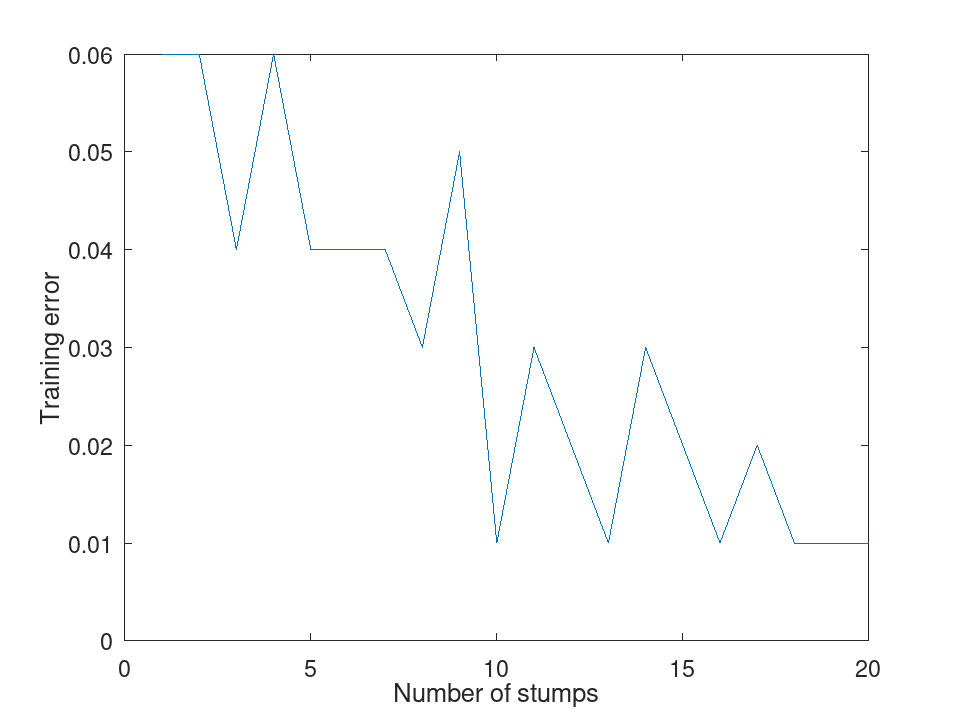
Boost decision stumps to tell versicolor from virginica, and see how the training error falls as the stumps accumulate.
 load fisheriris
 X = meas(51:150,:);
 Y = species(51:150);
 Mdl = fitcensemble (X, Y, 'Method', 'AdaBoostM1', ...
                     'NumLearningCycles', 20, ...
                     'Learners', templateTree ('MaxNumSplits', 1));
 err = loss (Mdl, X, Y, 'Mode', 'cumulative');
 plot (err);
 xlabel ('Number of stumps');
 ylabel ('Training error');
A bagged ensemble of trees classifies all three species, and scores each flower with the average of its trees' class probabilities.
 load fisheriris
 rng (42);
 Mdl = fitcensemble (meas, species, 'Method', 'Bag', ...
                     'NumLearningCycles', 30);
 [label, scores] = predict (Mdl, [5.0, 3.4, 1.5, 0.2; 6.7, 3.0, 5.2, 2.3])
label =
  2x1 cell array

    {'setosa'   }
    {'virginica'}

scores =

   1   0   0
   0   0   1
Fit from a table, and predict on one
 load fisheriris
 T = table (meas(:,1), meas(:,2), meas(:,3), meas(:,4), ...
            'VariableNames', {'SL', 'SW', 'PL', 'PW'});
 T.Species = categorical (species);
A column holding levels is a categorical predictor without being named one
T.Wide = categorical (meas(:,2) > 3, [false true], {'narrow', 'wide'});
The response is named by its column, and everything else is a predictor
 Mdl = fitcensemble (T, 'Species');
 Mdl.PredictorNames
ans =
  1x5 cell array

    {'SL'}    {'SW'}    {'PL'}    {'PW'}    {'Wide'}
Mdl.CategoricalPredictors
ans = 5
predict reads a table by the names the model was fitted on, so the columns may come in any order
 label = predict (Mdl, T(1:5, [6, 5, 4, 3, 2, 1]));
 label'
ans =
  1x5 categorical array

    setosa    setosa    setosa    setosa    setosa