Categories &
Functions List
- adtest
- anova
- anova1
- anova2
- anovan
- ansaribradley
- barttest
- binotest
- chi2gof
- chi2test
- correlation_test
- detectdrift
- dwtest
- fishertest
- friedman
- hotelling_t2test
- hotelling_t2test2
- jbtest
- knntest
- kruskalwallis
- kstest
- kstest2
- lillietest
- manova1
- mcnemar_test
- meanEffectSize
- mmdtest
- multcompare
- ranksum
- regression_ftest
- regression_ttest
- rjtest
- runstest
- signrank
- signtest
- stats.drift.DriftDiagnostics
- swtest
- ttest
- ttest2
- vartest
- vartest2
- vartestn
- ztest
- ztest2
- CompactLinearModel
- CoxModel
- coxphfit
- fitcox
- fitglm
- fitglme
- fitlm
- fitlme
- fitlmematrix
- fitmnr
- fitnlm
- fitrm
- GeneralizedLinearMixedModel
- GeneralizedLinearModel
- glmfit
- glmval
- invpred
- lasso
- lassoglm
- LinearFormula
- LinearMixedModel
- LinearModel
- logistic_regression
- mnrfit
- mnrval
- monotone_smooth
- MultinomialRegression
- mvregress
- mvregresslike
- nlinfit
- nlparci
- nlpredci
- NonLinearModel
- plsregress
- regress
- regress_gp
- RepeatedMeasuresModel
- ridge
- robustfit
- stepwisefit
- stepwiseglm
- stepwiselm
- ClassificationBaggedEnsemble
- ClassificationDiscriminant
- ClassificationECOC
- ClassificationEnsemble
- ClassificationGAM
- ClassificationKernel
- ClassificationKNN
- ClassificationLinear
- ClassificationNaiveBayes
- ClassificationNeuralNetwork
- ClassificationPartitionedECOC
- ClassificationPartitionedEnsemble
- ClassificationPartitionedKernel
- ClassificationPartitionedLinear
- ClassificationPartitionedModel
- ClassificationSVM
- ClassificationTree
- CompactClassificationDiscriminant
- CompactClassificationECOC
- CompactClassificationEnsemble
- CompactClassificationGAM
- CompactClassificationNaiveBayes
- CompactClassificationNeuralNetwork
- CompactClassificationSVM
- CompactClassificationTree
- CompactRegressionGAM
- CompactRegressionEnsemble
- CompactRegressionGP
- CompactRegressionNeuralNetwork
- CompactRegressionSVM
- CompactRegressionTree
- CompactTreeBagger
- designecoc
- fcnnpredict
- fcnntrain
- fitcdiscr
- fitcecoc
- fitcensemble
- fitcgam
- fitckernel
- fitcknn
- fitclinear
- fitcnb
- fitcnet
- fitcsvm
- fitctree
- fitrensemble
- fitrgam
- fitrgp
- fitrkernel
- fitrlinear
- fitrnet
- fitrsvm
- fitrtree
- fitSVMPosterior
- gamboostinter
- gamboostpairs
- gamboostpredict
- gamboosttrain
- gampredict
- gamtrain
- partialDependence
- plotPartialDependence
- PredictiveModel
- RegressionBaggedEnsemble
- RegressionEnsemble
- RegressionGAM
- RegressionGP
- RegressionKernel
- RegressionLinear
- RegressionNeuralNetwork
- RegressionPartitionedEnsemble
- RegressionPartitionedKernel
- RegressionPartitionedLinear
- RegressionPartitionedModel
- RegressionSVM
- RegressionTree
- lime
- shapley
- svmpredict
- svmtrain
- templateDiscriminant
- templateEnsemble
- templateKernel
- templateKNN
- templateLinear
- templateNaiveBayes
- templateSVM
- templateTree
- TreeBagger
- treepredict
- treetrain
- paretotails
- prob.ProbabilityDistribution
- prob.BetaDistribution
- prob.BinomialDistribution
- prob.BirnbaumSaundersDistribution
- prob.BurrDistribution
- prob.ExponentialDistribution
- prob.ExtremeValueDistribution
- prob.GammaDistribution
- prob.GeneralizedExtremeValueDistribution
- prob.GeneralizedParetoDistribution
- prob.HalfNormalDistribution
- prob.InverseGaussianDistribution
- prob.KernelDistribution
- prob.LogisticDistribution
- prob.LoglogisticDistribution
- prob.LognormalDistribution
- prob.LoguniformDistribution
- prob.MultinomialDistribution
- prob.NakagamiDistribution
- prob.NegativeBinomialDistribution
- prob.NormalDistribution
- prob.PiecewiseLinearDistribution
- prob.PoissonDistribution
- prob.RayleighDistribution
- prob.RicianDistribution
- prob.StableDistribution
- prob.tLocationScaleDistribution
- prob.TriangularDistribution
- prob.UniformDistribution
- prob.WeibullDistribution
- betafit
- betalike
- binofit
- binolike
- bisafit
- bisalike
- burrfit
- burrlike
- copulafit
- evfit
- evlike
- expfit
- explike
- gamfit
- gamlike
- geofit
- gevfit
- gevlike
- gevfit_lmom
- gpfit
- gplike
- gumbelfit
- gumbellike
- hnfit
- hnlike
- invgfit
- invglike
- logifit
- logilike
- loglfit
- logllike
- lognfit
- lognlike
- nakafit
- nakalike
- nbinfit
- nbinlike
- normfit
- normlike
- poissfit
- poisslike
- raylfit
- rayllike
- ricefit
- ricelike
- stblfit
- stbllike
- tlsfit
- tlslike
- unidfit
- unifit
- wblfit
- wbllike
- betacdf
- betainv
- betapdf
- betarnd
- binocdf
- binoinv
- binopdf
- binornd
- bisacdf
- bisainv
- bisapdf
- bisarnd
- burrcdf
- burrinv
- burrpdf
- burrrnd
- bvncdf
- bvtcdf
- cauchycdf
- cauchyinv
- cauchypdf
- cauchyrnd
- chi2cdf
- chi2inv
- chi2pdf
- chi2rnd
- copulacdf
- copulapdf
- copularnd
- evcdf
- evinv
- evpdf
- evrnd
- expcdf
- expinv
- exppdf
- exprnd
- fcdf
- finv
- fpdf
- frnd
- gamcdf
- gaminv
- gampdf
- gamrnd
- geocdf
- geoinv
- geopdf
- geornd
- gevcdf
- gevinv
- gevpdf
- gevrnd
- gpcdf
- gpinv
- gppdf
- gprnd
- gumbelcdf
- gumbelinv
- gumbelpdf
- gumbelrnd
- hncdf
- hninv
- hnpdf
- hnrnd
- hygecdf
- hygeinv
- hygepdf
- hygernd
- invgcdf
- invginv
- invgpdf
- invgrnd
- iwishpdf
- iwishrnd
- jsucdf
- jsupdf
- laplacecdf
- laplaceinv
- laplacepdf
- laplacernd
- logicdf
- logiinv
- logipdf
- logirnd
- loglcdf
- loglinv
- loglpdf
- loglrnd
- logncdf
- logninv
- lognpdf
- lognrnd
- mnpdf
- mnrnd
- mvncdf
- mvnpdf
- mvnrnd
- mvtcdf
- mvtpdf
- mvtrnd
- nakacdf
- nakainv
- nakapdf
- nakarnd
- nbincdf
- nbininv
- nbinpdf
- nbinrnd
- ncfcdf
- ncfinv
- ncfpdf
- ncfrnd
- nctcdf
- nctinv
- nctpdf
- nctrnd
- ncx2cdf
- ncx2inv
- ncx2pdf
- ncx2rnd
- normcdf
- norminv
- normpdf
- normrnd
- plcdf
- plinv
- plpdf
- plrnd
- poisscdf
- poissinv
- poisspdf
- poissrnd
- raylcdf
- raylinv
- raylpdf
- raylrnd
- ricecdf
- riceinv
- ricepdf
- ricernd
- stblcdf
- stblinv
- stblpdf
- stblrnd
- stdrcdf
- stdrinv
- stdrpdf
- stdrrnd
- tcdf
- tinv
- tpdf
- trnd
- tlscdf
- tlsinv
- tlspdf
- tlsrnd
- tricdf
- triinv
- tripdf
- trirnd
- unidcdf
- unidinv
- unidpdf
- unidrnd
- unifcdf
- unifinv
- unifpdf
- unifrnd
- vmcdf
- vminv
- vmpdf
- vmrnd
- wblcdf
- wblinv
- wblpdf
- wblrnd
- wienrnd
- wishpdf
- wishrnd
- betastat
- binostat
- bisastat
- burrstat
- chi2stat
- copulaparam
- copulastat
- evstat
- expstat
- fstat
- gamstat
- geostat
- gevstat
- gpstat
- gumbelstat
- hnstat
- hygestat
- invgstat
- logistat
- loglstat
- lognstat
- nakastat
- nbinstat
- ncfstat
- nctstat
- ncx2stat
- normstat
- plstat
- poisstat
- raylstat
- ricestat
- stdrstat
- tlsstat
- tristat
- tstat
- unidstat
- unifstat
- wblstat
- andrewsplot
- bar3
- bar3h
- biplot
- blandAltmanPlot
- boxchart
- boxplot
- cdfplot
- dendrogram
- ecdfhist
- einstein
- gardnerAltmanPlot
- glyphplot
- gplotmatrix
- gscatter
- heatmap
- hist3
- histfit
- manovacluster
- normplot
- parallelcoords
- parallelplot
- ppplot
- probplot
- qqplot
- scatterhist
- scatterhistogram
- silhouette
- stats.chart.BoxChart
- stats.chart.HeatmapChart
- stats.chart.ParallelCoordinatesPlot
- stats.chart.ScatterHistogramChart
- swarmchart
- violin
- wblplot
Function Reference: relieff
statistics: idx = relieff (X, Y, k)
statistics: idx = relieff (X, Y, k, name, value)
statistics: [idx, weights] = relieff (…)
Rank the importance of predictors with the ReliefF or RReliefF algorithm.
idx = relieff (X, Y, k) ranks the
predictors, the columns of the matrix X, by how well they tell apart
observations with different responses Y, judged by the k
nearest neighbors of each observation. idx is a row vector of
column indices, from the most important predictor to the least.
X is a matrix of type double or single, with one row per observation.
Y holds one response per row of X: a numeric vector, a logical
vector, a categorical vector, a cell array of character vectors, a string
array, or a character matrix with one row per observation. A numeric
Y is a regression problem and any other type a classification
problem, unless 'method' says otherwise. Rows with a missing value
(NaN) in X or a missing response (NaN, an empty or
blank name, or an undefined category) are left out. k is a positive
integer.
[idx, weights] = relieff (…) also returns the
weight of each predictor, a row vector in the order of the columns of
X, of type double. A larger weight marks a more important predictor,
and weights range from -1 to 1. idx sorts weights in
descending order.
Predictors are compared on their range: for continuous predictors, the
difference between two observations in predictor j is
|x_rj - x_qj| divided by the range of predictor j, and the
distance between them is the sum of these differences over all predictors
(city block distance). A predictor holding a single value is left out of
the distance and has weight NaN, ranked last. For categorical
predictors the difference is 0 when two observations share a value and 1
otherwise. The neighbors of an observation are the k observations
nearest to it, ties between equal distances going to the observation that
comes first in X. Each neighbor counts with a weight that falls with
its rank i among them as exp (-(i / sigma)^2), normalized to
sum to 1 over the neighbors.
For classification (ReliefF), each observation r has k nearest neighbors in its own class (hits) and k in each of the other classes (misses), or the whole class when it holds fewer. The weight of predictor j falls by the weighted difference to the hits and rises by the weighted difference to the misses of class c, scaled by p_c / (1 - p_r), p being the prior probabilities of the classes; each observation adds 1/m of its own share, m being the number of observations used. For regression (RReliefF), with dy the difference of two responses divided by the range of Y and dj the difference in predictor j, the weighted sums of dy, dj and dy dj over the k nearest neighbors of each observation are accumulated as W_dy, W_dj and W_dydj, and the weight of predictor j is W_dydj / W_dy - (W_dj - W_dydj) / (m - W_dy).
The following Name-Value pairs are supported:
| Name | Value |
|---|---|
'method' | 'classification' or
'regression'. The default is 'regression' for a numeric
Y and 'classification' otherwise. A numeric Y may be
classified, its distinct values being the classes, but only a numeric
Y can be regressed. |
'prior' | The prior probabilities of the classes, for
classification only: 'empirical', the class frequencies in Y,
which is the default; 'uniform', equal for every class; a numeric
vector with one value per class; or a structure with the fields
group, the class names, and prob, their probabilities. A
numeric vector follows the order of the classes in Y: sorted values
for a numeric, logical or categorical Y, and order of first
appearance for text. A structure must name every class of Y and may
name others, which are ignored. The probabilities are normalized to sum
to 1, and the observations of a class with prior probability 0 are left
out. |
'updates' | The number of observations, drawn at random
without replacement, for which neighbors are sought: a positive integer, or
'all', the default, for every observation. A number at least as
large as the number of observations uses them all. |
'categoricalx' | 'on' to treat every predictor as
categorical, or 'off', the default, to treat every predictor as
continuous. |
'sigma' | The distance scaling factor of the rank weights
of the neighbors, a positive scalar. The default is Inf for
classification, weighing all neighbors alike, and 50 for regression. |
When X is single, the weights are computed in single precision and
returned as double. The option names are not case sensitive but must be
given in full, where MATLAB accepts any shortened name. Where MATLAB
accepts a non-integer k or 'updates', answers for complex or
infinite values in X, gives weights for a single class of responses,
and returns NaN for a constant response, relieff refuses
them. It also accepts numeric class names in a 'prior' structure,
which MATLAB refuses.
References:
- I. Kononenko, E. Simec and M. Robnik-Sikonja. Overcoming the myopia of inductive learning algorithms with RELIEFF. Applied Intelligence, 7(1):39–55, 1997.
- M. Robnik-Sikonja and I. Kononenko. Theoretical and empirical analysis of ReliefF and RReliefF. Machine Learning, 53(1-2):23–69, 2003.
See also: pca, fitcknn, knnsearch
Source Code: relieff
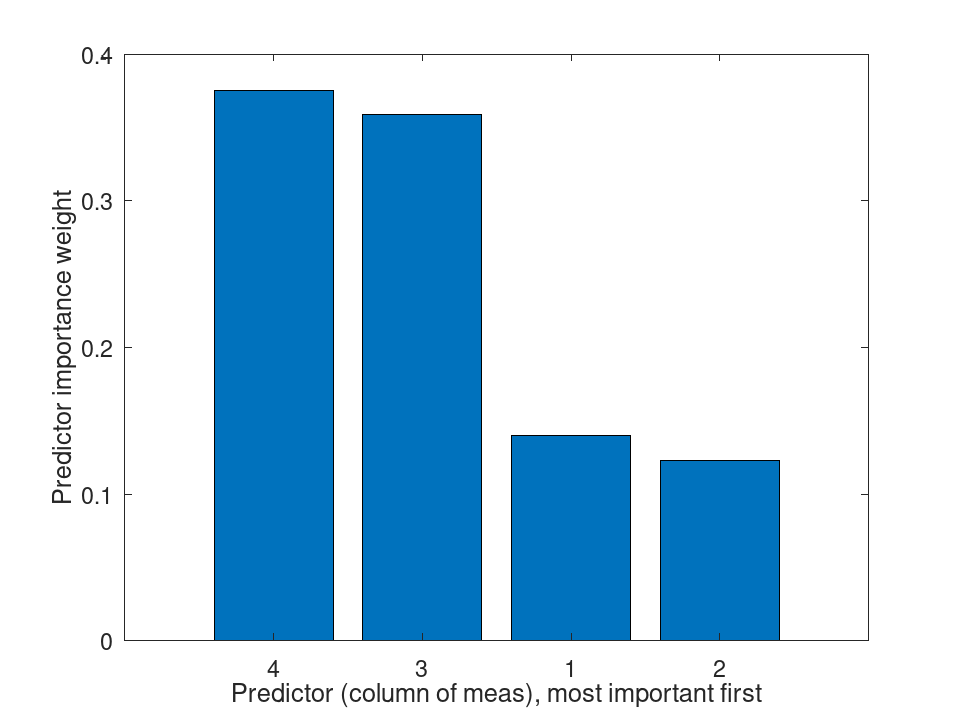
Rank the four measurements of the iris flowers by how well they tell the three species apart
 load fisheriris
 [idx, weights] = relieff (meas, species, 10);
 bar (weights(idx));
 xticks (1:4);
 xticklabels (cellstr (num2str (idx')));
 xlabel ("Predictor (column of meas), most important first");
 ylabel ("Predictor importance weight");